Gemini 4 Carbon is GA: when should agents use it over Argon?
Gemini 4 Carbon became GA on November 10, 2026: Argon's 1M context and price with more thinking per turn, and prices double on December 1.
Key takeaways
- Gemini 4 Carbon became generally available on the Gemini API paid tier on November 10, 2026.
- It shares Argon's 1M-token context, tools and per-token price but spends more thinking tokens per turn.
- Pricing is $2 input and $10 output per million tokens through November 30, then $4 and $20.
- Carbon ignores temperature, top_p and top_k and does not support explicit context caching.
On this page
- What is Gemini 4 Carbon?
- How is Carbon different from Argon?
- What do the benchmarks say?
- How do long decodes and the 1M window work?
- What breaks when you move an agent to Carbon?
- What will Carbon cost after November 30?
- What does this mean for teams running AI agents?
- What are the limits and open questions?
Gemini 4 Carbon (gemini-4-carbon) became generally available in the Gemini API on November 10, 2026, at $2 per million input tokens and $10 per million output tokens through November 30 [2]. It shares Gemini 4 Argon's 1M-token context, tools and price but thinks longer per turn, so Google positions it for long, hard agent tasks and keeps Argon as the default for most coding and knowledge work [1][3].
What is Gemini 4 Carbon?
Gemini 4 Carbon is Google's strongest Gemini model, which Google describes as having "frontier performance in cybersecurity capabilities and long-horizon agentic workflows" [1]. Google announced it on October 28, 2026, two weeks after Gemini 4 Argon, and at first gave access only to a subset of cyber defenders through the Fairwind Program [5].
The November 10 release opens it to everyone else who pays. Developers get it on the Gemini API paid tier in Google AI Studio and Android Studio; enterprises get it in Gemini for business, Google Antigravity and CodeMender; and Google AI Ultra subscribers get it as it rolls out in Antigravity, the Gemini app and AI Mode in Search [1]. It is not available on the Gemini API Free tier [3].
The same day, GitHub made Gemini 4 Carbon generally available in GitHub Copilot for Copilot Pro+, Max, Business and Enterprise, in the model picker of VS Code, Copilot CLI, the Copilot coding agent, JetBrains IDEs and other surfaces, billed at provider list pricing under usage-based billing [6].
How is Carbon different from Argon?
Carbon is Argon with a larger thinking habit. The "What's new" guide says the two models share the same unified 1M-token context window, built-in tools and per-token price, but Carbon spends more thinking tokens per turn to explore hypotheses and verify its work, which raises per-turn token use and latency [3].
| Gemini 4 Argon | Gemini 4 Carbon | |
|---|---|---|
| Model ID | gemini-4-argon | gemini-4-carbon |
| Context | 1M unified tokens | 1M unified tokens |
| Thinking levels | low, medium, high | low, medium (default), high |
| Price to November 30 (input / output per 1M) | $2 / $10 | $2 / $10 |
| Thinking tokens per turn | Fewer | More |
| Google's suggested use | Interactive coding, fast production loops | Long agentic work, design, coordination, auditing, security |
Sources for the table: [3][1].
Google is explicit that Carbon is not a blanket upgrade: "Argon remains the ideal choice for the majority of software engineering and knowledge work" [1]. The guide adds that Argon should stay on latency-sensitive workloads [3].
What do the benchmarks say?
The numbers are Google's own and should be read as such. At announcement, Google reported that Carbon ranked first on the Artificial Analysis Intelligence Index v5.0 with a score of 59, scored 88.2% on SEC-bench Pro (finding vulnerabilities), 54.8% on ExploitGym (exploitation) and 71.0% on CWE-bench (patching), and had a 0.0% attack success rate on Gray Swan's indirect prompt injection benchmark, against 0.7% for Argon [5].
The safety figures in the GA post matter more for agents that act on their own. Against an adaptive red-teaming agent in simulated attack environments, the per-attempt breach rate fell to 0.8%, from 3.1% on Argon, and on a 375-task agentic honesty benchmark Carbon passed 92% of tasks against 70% for Argon [1]. Google also says resistance to prompt injection remains an area for improvement, so the 0.0% result is not a reason to drop your own input filtering.
How do long decodes and the 1M window work?
Input, thinking and output share one window of 1,048,576 tokens, and a standard synchronous response stops at 65,536 tokens [3]. To go past that, you run the request in background mode with max_output_tokens above 65,536; the server then generates in continuation hops of 64K tokens, and each hop adds a separate model_output step that you join yourself.
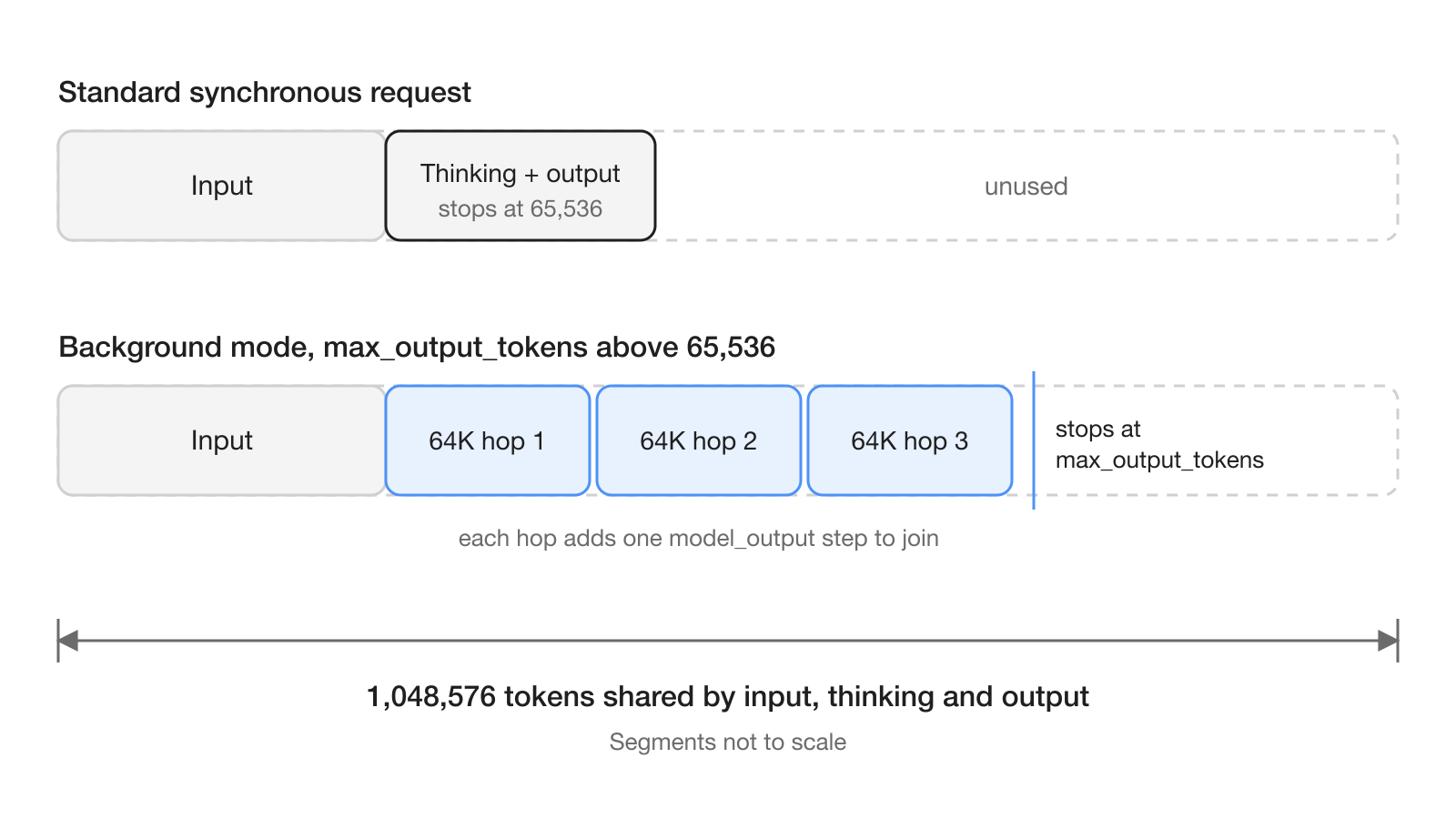
max_output_tokens caps thinking and visible output together, so a low cap can be consumed by reasoning before the answer is complete [3]. The guide recommends keeping the 65,536 default for standard tasks, raising any existing cap below 32K to at least 32,768, and using background mode with 131,072 or 262,144 tokens for complex reasoning or coding.
This is the background long-decode pattern from the guide, trimmed to the parts an agent needs:
import time
from google import genai

client = genai.Client()

interaction = client.interactions.create(
    model="gemini-4-carbon",
    input="Audit this repository's retry logic and propose a patch.",
    background=True,
    generation_config={
        "max_output_tokens": 262144,
        "thinking_level": "high",
    },
)

while interaction.status in ("in_progress", "queued"):
    time.sleep(5)
    interaction = client.interactions.get(id=interaction.id)

# Each continuation hop is its own model_output step.
text = "".join(
    content.text
    for step in interaction.steps
    if step.type == "model_output"
    for content in step.content
    if content.type == "text"
)
print(text)
On Google Cloud's Gemini Enterprise Agent Platform, the developer guide lists a known issue: long decoding requires the v1beta1 API, and changing model, system_instruction or function declarations between continuation segments returns HTTP 400 [4]. In foreground continuation, each segment re-prefills the conversation and previously generated tokens as input, so usage.total_input_tokens increases across segments; stateless and custom loops must resend the original input [4].
What breaks when you move an agent to Carbon?
From Argon, almost nothing: the guide says to change the model ID, keep thinking_level at medium unless a workload needs high, and make sure max_output_tokens and HTTP timeouts allow for longer reasoning, with no request schema changes [3]. From Gemini 3 and earlier, the list is longer.
The checklist for Gemini 3 and earlier, from the guide [3]:
- Change the model ID to
gemini-4-carbon. - Raise an explicit
max_output_tokensto at least 32,768. - Pick a thinking level (
low,mediumorhigh) and test all three. - Remove explicit caching calls and
cached_contentreferences; implicit caching applies to prompts of at least 4,096 tokens. - Remove
temperature,top_pandtop_k. - Use background mode for outputs over 64K tokens.
- Use background mode or set HTTP timeouts to at least 15 minutes.
- Use
previous_interaction_idfor multi-turn and function-calling state. - Re-check cost estimates, since all processed tokens are billed.
The Google Cloud guide is stricter about some parameters than the Gemini API guide. On that platform, thinking_budget and the MINIMAL level return HTTP 400, frequency_penalty, presence_penalty and a candidate_count above 1 also return HTTP 400, and each FunctionResponse must match the id, name and order of its FunctionCall [4]. It also lists a second model, gemini-4-carbon-cyber-permissive, which defaults to HIGH thinking and is meant for cybersecurity workloads approved through the Fairwind Program.
What will Carbon cost after November 30?
Carbon's price doubles on December 1, 2026. The introductory rates are $2.00 per million input tokens, $0.10 for cached input and $10.00 for output including thinking; from December 1 they become $4.00, $0.20 and $20.00 [3].
| Component (per 1M tokens) | Through November 30, 2026 | From December 1, 2026 |
|---|---|---|
| Input | $2.00 | $4.00 |
| Cached input (implicit caching) | $0.10 | $0.20 |
| Output, including thinking | $10.00 | $20.00 |
Thinking is where the real bill hides. All processed tokens are billed, including thinking tokens and the internal tool instructions and function declarations used with grounding, and Grounding with Google Search is billed per query on top [3]. Because Carbon thinks more per turn than Argon at the same per-token price, the same task usually costs more on Carbon; measure it on your own traces before switching a high-volume agent.
What does this mean for teams running AI agents?
For teams, Carbon is a model for the hard step, not for every step. Google suggests assigning it to roles that demand the deepest reasoning, such as architectural design, coordination and auditing, and recommends pairing it with faster, lighter models for parallel work [1]. A practical split is Argon or a Flash model for the agents that draft, search and edit, and Carbon for the reviewer or planner whose mistakes are expensive.
If your team uses Copilot, admins on Business and Enterprise control access through the model policy, and new models are enabled by default unless an admin has turned that off [6]. Check that setting before Carbon shows up in every developer's picker with usage-based billing attached.
What are the limits and open questions?
Several things are not settled. The Gemini API guide does not list rate limits for Carbon and points only to the pricing page [3], and the Google Cloud guide says the model is available to verified enterprise customers in select regions (global, us or eu) [4]. The /swarm command in Google Antigravity, which coordinates a team of agents from one prompt, is still a preview [1]. And the benchmark results are vendor-reported; none of them tells you how many extra thinking tokens your own agent will spend per task, which is the number that decides whether Carbon is worth it.
Frequently asked questions
What is the model ID for Gemini 4 Carbon?
The Gemini API model ID is gemini-4-carbon. On Google Cloud's Gemini Enterprise Agent Platform there is also gemini-4-carbon-cyber-permissive, which defaults to high thinking and is meant for cybersecurity workloads approved through the Fairwind Program.
Is Gemini 4 Carbon better than Gemini 4 Argon?
Carbon thinks longer per turn and is aimed at long, hard agentic, scientific and security tasks. Google still calls Argon the ideal choice for most software engineering and knowledge work, and recommends Argon for latency-sensitive workloads.
How much does Gemini 4 Carbon cost?
Through November 30, 2026, input costs $2.00, cached input $0.10 and output including thinking $10.00 per million tokens. From December 1, 2026 the rates are $4.00, $0.20 and $20.00.
Can I use Gemini 4 Carbon on the Gemini API free tier?
No. Google's Gemini 4 Carbon guide says the model is available on the paid tier of the Gemini API and Google AI Studio and is not available on the Free tier.
Does Gemini 4 Carbon support temperature?
No. Carbon does not support temperature, top_p or top_k; the Gemini API ignores them if sent. Google's Cloud developer guide says to control reasoning depth with thinking_level and output format with response_schema.