What is self-hosted Claude Managed Agents, and what do you run?
Self-hosted Claude Managed Agents, launched November 12, 2026, runs the agent loop, sessions and sandboxes on your own infrastructure.
Key takeaways
- Anthropic launched self-hosted Claude Managed Agents on November 12, 2026.
- You run cma-server, a PostgreSQL 16+ database and workers that run the agent's tools.
- Model calls go to the Claude API by default, or to Bedrock, Google Cloud, Foundry or a gateway.
- Webhooks, scheduled deployments, the Files API and dynamic workflows are unavailable when self-hosted.
On this page
Self-hosted Claude Managed Agents, launched by Anthropic on November 12, 2026, lets you run the whole Managed Agents service on your own cloud account or in your own data center. You host the API, the agent loop, the database of agents, sessions and session history, and the sandboxes where tools run. Model calls go to the Claude API by default, or to a provider you choose. You request access through your Anthropic account team [1].
What is self-hosted Claude Managed Agents?
It is the third way to run Managed Agents, and the first in which Anthropic hosts nothing but the model. The documentation splits Managed Agents into two parts you can host: the sandboxes, where an agent's tools run commands and edit files, and the service, which is the API, the agent loop and the storage for agents, sessions and session history [2]. Self-hosted sandboxes already moved the first part to you. This release moves the second part too.
| Option | Sandboxes | Service | Model |
|---|---|---|---|
| Cloud sandboxes (default) | Anthropic | Anthropic | Anthropic |
| Self-hosted sandboxes | You | Anthropic | Anthropic |
| Self-hosted Managed Agents | You | You | Anthropic, or a provider you choose |
Your server exposes the same API as the hosted service, so the Claude SDK and the ant CLI work against it, and the rest of the Managed Agents documentation applies except for a documented list of differences [2]. In client code, two things change: the base URL becomes your server's address, and the API key becomes your server API key instead of a Claude API key [6].
Anthropic names two reasons to choose it: you must store agents, sessions and session history on your own infrastructure, or your model calls must go to Amazon Bedrock, Claude Models on Google Cloud (Google managed), Microsoft Foundry or your own model gateway. If you only need tools to run on your infrastructure, the documentation points you to self-hosted sandboxes instead [2].
How does a self-hosted deployment work?
A deployment is one or more servers, their database and your sandboxes, all inside your network; the server sends each model call out to the inference provider you configure [2].
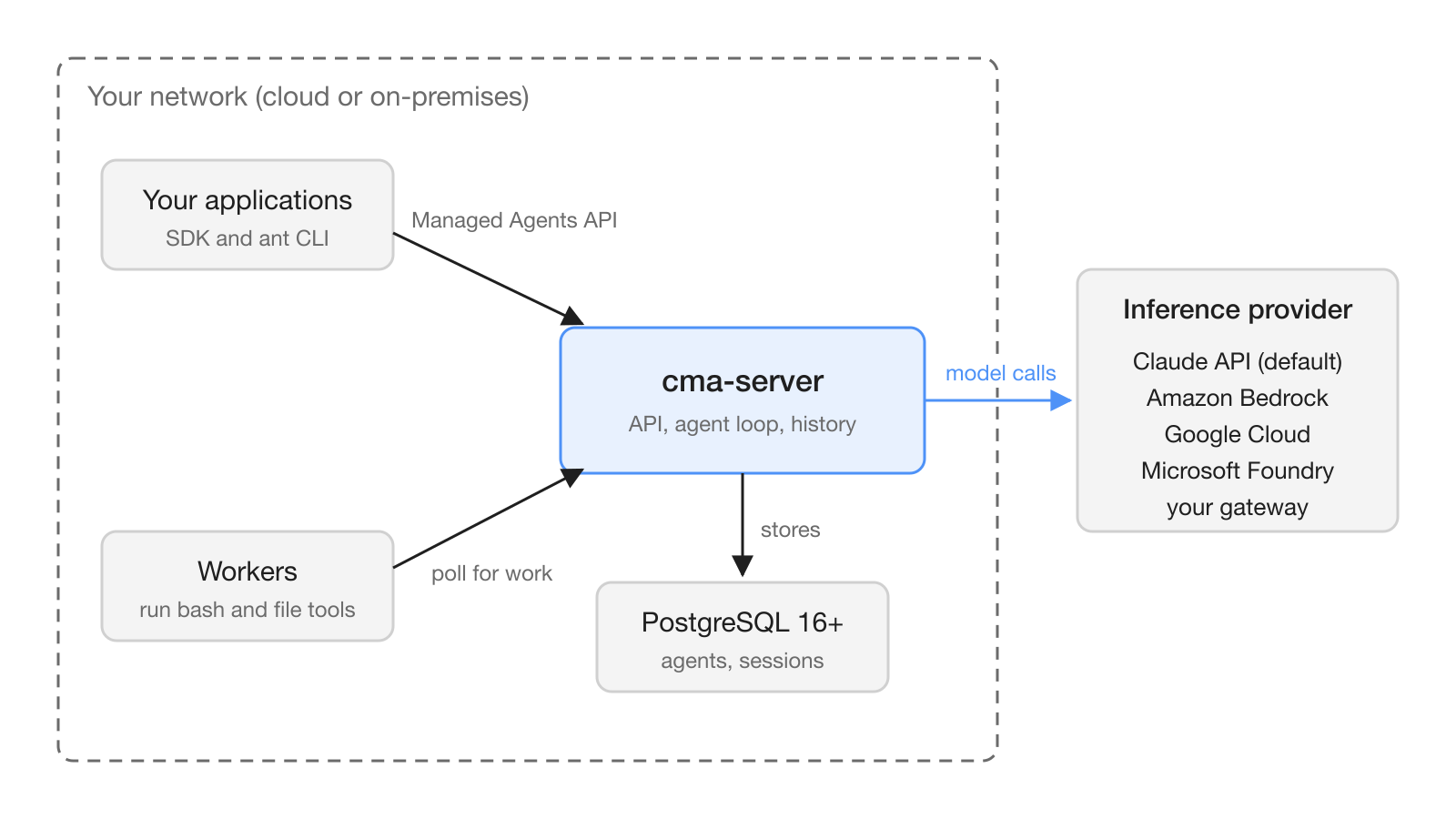
The parts are:
cma-serverserves the API, runs the agent loop, stores agents, sessions and history, and calls your inference provider. It never runs an agent's shell or file tools [2].- The database is PostgreSQL 16 or later. Without one, the server keeps its data in memory and a restart erases it.
- Workers take work from the server and run the agent's shell and file tools in your sandboxes. A worker is an
ant beta:workercommand or an SDK worker. - A console on your server lets people sign in through your identity provider to create agents and run sessions.
cma-server-admin, the admin CLI, creates environments and their environment keys. It runs on Linux (x86-64 and Arm) and on macOS with Apple silicon.
Three credentials hold this together: a server API key that your applications send, an inference credential that only the server uses for model calls, and an environment key that workers use to poll one environment's queue [2]. Environments and their keys come from the admin CLI, not the Claude Console, and an environment key stops working after 365 days [6].
Where do model calls go?
The server's inference.provider setting decides it. The values are anthropic (the default, the Claude API), bedrock, vertex for Claude Models on Google Cloud (Google managed), foundry and gateway for a model gateway that you run [4]. Agents keep naming models by their Claude API IDs, such as claude-opus-5-5, and the server translates the ID for the provider. A Bedrock setup looks like this:
inference:
  provider: bedrock
  region: us-east-1
A gateway can accept requests in the Claude Messages format, Amazon Bedrock's InvokeModel format, or the rawPredict format of Claude Models on Google Cloud, and it can take short-lived tokens through an OAuth exchange [4]. After a change, the server log line upstream credential resolved confirms the credential. It does not prove that your account has the model enabled.
Some features depend on the provider. The web_search tool works under anthropic, vertex and foundry; web_fetch works under anthropic and foundry; inference_geo works only under anthropic [3]. Under anthropic, the server also asks for server-side fallback by default, so another Claude model can answer when a safety classifier declines a request; inference.model_fallback: false turns that off.
What data leaves your network?
The server connects only to destinations you configure: your inference provider, its database, the MCP servers and Git hosts you allow, and optional services such as an OpenTelemetry collector, single sign-on or a secret manager [5]. Each model call carries the conversation so far, including prompts, tool inputs and tool results. The server connects to Anthropic only when the Claude API is its inference provider, and Anthropic has no remote access to the server or its log.
Two details matter for a security review. When the Claude API serves the model, each call carries up to three headers with the IDs of the session, the agent and the environment, and no setting turns them off; under other providers, the server never sends them. Calls to the Claude API, to Microsoft Foundry and to a Messages-format gateway can also carry the label cma-server in metadata.user_id, which is the same on every server [5].
Retention follows the same split. Sessions stay in your database until you delete them, and the server deletes nothing because of its age. The data retention page lists hosted Managed Agents as not covered by zero data retention because Anthropic stores the transcripts; on your own server, you store them, and a ZDR arrangement covers the model calls to the Claude API like other Messages API calls [5].
What is missing compared with the hosted service?
Several hosted features are not available, and nothing carries over: agents, skills, vault credentials, memory stores and session history must be created again on your server [3].
| Hosted feature | On your server | What to do instead |
|---|---|---|
| Cloud environments | Return a 400 error | Run self-hosted workers |
| Messages API and Models API | Return 404 | Call the Claude API or your provider directly |
Files API and file resources | Not available | Use the worker's working directory, or base64 in messages |
mcp_oauth vault credentials | Rejected | Store a static_bearer token and rotate it yourself |
Prebuilt docx, pdf, pptx, xlsx skills | Rejected | Upload their sources as custom skills |
| Scheduled deployments | No routes | Start scheduled sessions from your own scheduler, such as cron |
| Dreams | No routes | No replacement |
| Webhooks | Never sent | Follow the event stream; keep workers polling |
Multiagent orchestration is narrower too. The server accepts only a coordinator block that lists 1 to 20 subagents; dynamic workflows, the advisor and subagents the agent defines itself are not available, and the multiagent_20261001 type from the hosted examples returns a 400 error [3].
Some features need a setting first. The server connects only to MCP hosts listed in mcp.allowed_hostnames, which match exactly and start empty; an MCP server inside your private network then needs no MCP tunnel. Git hosts need an entry in git.allowed_hostnames, pushes are limited to git.allowed_push_refs, and the Git token never reaches the sandbox. The web_search and web_fetch tools stay off until you set web_tools.enabled: true [3].
mcp:
  allowed_hostnames:
    - mcp.example.com
git:
  allowed_hostnames:
    - github.com
  allowed_push_refs:
    - refs/heads/agent/
web_tools:
  enabled: true
What does this mean for teams running AI agents?
The main change is that the agent loop and the session archive can now sit next to your code and internal systems, in a database your own security team controls. The cost is operations: you run and secure a server, its database and your sandboxes, and you install each release yourself [2].
Isolation also follows deployments, not environments. Each deployment serves one tenant at one trust level, the server API key reaches every environment, and an environment key can read events in every session of its environment [5]. If trusted and untrusted work share a server, give each its own deployment, with its own database, server API key and workers. A team that runs agents for several groups from one shared workspace, such as Hardi AI, would map each trust boundary to its own deployment.
How do you try it?
Start with the Docker Compose quickstart on one machine, then move to the Helm charts for production [7]. The Compose stack runs the server, its PostgreSQL database and a set of workers that start a sandbox container for each session. It serves plain HTTP and is meant for development only.
- Get the release archive from your Anthropic account team, and prepare a host with at least 2 CPUs, Docker Engine with the Compose plugin,
openssland theantCLI. - Create the
.envfile the quickstart describes, with your Claude API key, a generated server API key and the other generated secrets. - Run
docker compose up --build -dand wait until/cma-server/readyzanswers with a ready status. - In a second terminal, set
ANTHROPIC_BASE_URLto the server address andANTHROPIC_API_KEYto the server API key, then create an agent and a session with theantCLI. - Ask the agent to run
hostname. A name that starts withcma-sandbox-confirms the tool ran in a sandbox container [7].
Keep docker compose in the first terminal. If Compose inherits ANTHROPIC_BASE_URL pointing at your own server, the server calls itself instead of the Claude API.
What are the limits and open questions?
The release notes give no price and no general availability date for self-hosting, and access goes through account teams only [1]. The Compose stack has two practical limits: it starts 10 workers that each serve one session at a time, and a sandbox container exits about an hour after it starts, after which the turn continues in a fresh container with an empty /workspace [7][6]. Long turns should push their work as they go. Finally, MCP tool results above mcp.max_result_bytes, 100 KiB by default, are cut, and the rest is lost [3].
Frequently asked questions
What is the difference between self-hosted sandboxes and self-hosted Claude Managed Agents?
With self-hosted sandboxes you run only the containers where an agent's tools execute, and Anthropic runs the API, agent loop and session storage. With self-hosted Claude Managed Agents you run both the sandboxes and that service, and the model runs at Anthropic or a provider you choose.
Does self-hosted Claude Managed Agents send data to Anthropic?
Only when the Claude API is the inference provider. Then each model call carries the conversation so far and headers with session, agent and environment IDs; Anthropic has no remote access to the server or its log.
Can self-hosted Claude Managed Agents use Amazon Bedrock or Microsoft Foundry?
Yes. The server's inference.provider setting accepts anthropic, bedrock, vertex for Claude Models on Google Cloud (Google managed), foundry, or gateway for a model gateway you run. Agents keep using Claude API model IDs, which the server translates.
Can I move my hosted Managed Agents data to a self-hosted server?
No. Nothing is copied from the hosted service, including session history, so you create agents, skills, vault credentials and memory stores again on your own server.
Do webhooks and scheduled deployments work on a self-hosted server?
No. The self-hosted server sends no webhooks and has no routes for scheduled deployments, so you follow sessions through the event stream and start scheduled sessions from your own scheduler, such as cron.